
LOS ANGELES -- As Chris Curry read stories about UCLA’s possible move to the newly minted SoFi Stadium from the historic Rose Bowl, he found himself feeling increasingly frustrated.
As a lifelong Bruins fan, the president of Caranda Holdings — a real estate consultant company — said he shared a proposal for a stadium near campus in Westwood with members of the school’s athletic department in 2023.
Curry put together a pitch deck, including elements and images from an architecture firm he publicly declined to name. It promises that a stadium would boost school pride, advance recruiting efforts and generate millions of dollars for the university and its athletic programs.
“For (the) long term, it’s the best option, and also I think it’s the only way for the athletic department to really generate significant revenue from the football program,” Curry said. “I believe that the stadium would be full every game if it were sitting there on campus.”
Other experts, however, said that any feasibility study is largely irrelevant and that a stadium in Westwood is highly unlikely.
Eric Sussman, an adjunct professor of accounting at UCLA’s Anderson School of Management, said neighborhood opposition could be too strong for the proposal to withstand. The California Environmental Quality Act (CEQA) could also come into play, he said.
Though Curry disputed both ideas, saying that traffic, light pollution and shadows would not cause a prominent enough disturbance to residents.
“It’s one of those pipe dreams,” Sussman said. “It's been something people wanted for a long, long time.”
-06-544x306.jpg)
Pitch via Chris Curry
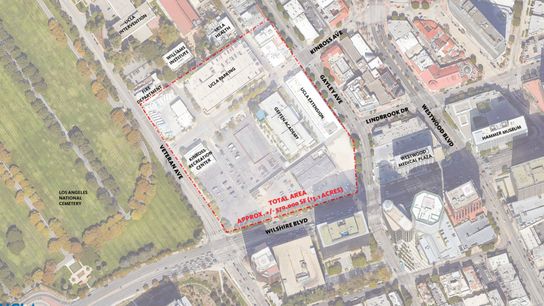
Curry’s proposal would situate a stadium off Wilshire Boulevard on a roughly 570,000-square-foot block between Veteran and Gayley Avenues, extending north through Kinross Avenue.
Curry said he designed the proposal, modeling the stadium dimensions after Oregon’s Autzen Stadium, not as a foolproof plan. Rather, he wanted to demonstrate to the athletic department that, with sufficient administrative will, a stadium in Westwood was possible for the Bruins.
Currently, there are two parking structures, the Geffen Academy — a university-affiliated high school — UCLA Extension campus, the Kinross Recreation Center and some non-university plots at Curry’s proposed site.
Pitch via Chris Curry
UCLA has also announced plans to develop an Arts Gateway Complex there in its Strategic Plan 2023-28. The university called the complex’s site the “last remaining undeveloped parcel of land that the campus owns.”
The development would include the Fowler Museum, potential faculty housing and a faculty center atop the tower(s), according to the plan. However, Curry said the stadium project would include three parcels to accommodate the Fowler Center development, the relocation of Geffen Academy and another development.
Peter Boumgarden, the Director of the Koch Family Center for Family Enterprise at WashU’s Olin Business School, said in a previous interview that an on-campus stadium would only be worth it if it didn’t come at the expense of other student projects. So, this type of proposal likely would have to bring in significant money for student projects, or else it wouldn’t be justifiable, in his opinion.
“It’s really important for university leaders to also say, ‘This is great. It adds to the student experience. But is it coming at the expense of other things that we could do with the same dollars?’” Boumgarden said.
The stadium would be built near the 405 Freeway, right next to the Metro D Line Subway extension, which is expected to be completed between winter 2026 and fall 2027, according to the Metro’s website.
It would seat 50,000 fans, including 52 suites and premium seating, for a total of 13,680 seats. Meanwhile, the rest would be general admission and student section seating.
Though Sussman said that 50,000 seats might not be adequate if UCLA can attract more interest by winning again.
"I'm not sure a 50,000-seat stadium is going to cut it anyway for these days," Sussman said. "If we return to our glory days under (coach Bob) Chesney, you'd have to have another stadium for bigger games anyhow."
-08-544x306.jpg)
Pitch via Chris Curry
Curry said he mocked up a parking study comparing the number of spaces within a 15-minute walk of the Rose Bowl and the proposed stadium. He found that the Rose Bowl provides 4,352 asphalt parking spaces, while UCLA could easily match that, plus another 20,000 in Century City, just a soon-to-be Metro stop away.
(Still, it is worth noting that the Rose Bowl actually offers 40,000 more spaces thanks to the Brookside Golf Club, according to the Washington Post, though it is unclear exactly how many are within a 15-minute walk.)
In Westwood, many of the immediate parking spots would belong to neighboring office buildings, which Sussman questioned the logistics of running them. Plus, tenants of those spaces who work on the weekends would be frustrated by the influx of vehicles, he noted.
“Let’s even say he's hypothetically correct, there are x 1,000’s of spots in x buildings, how are you going to coordinate that? How are you going to have the operations?” Sussman said.
The stadium’s total cost would be close to $950 million, a hefty sum. But when Curry proposed the stadium in 2023, he said the next steps would have been to identify a $125 million naming donor, whom he wanted to give the first opportunity to entertainment mogul David Geffen. He added that he wanted to get the project fast-tracked for use at the LA 2028 Olympics, but that ship has sailed by now.
UCLA could have also looked into a lease modification with the Rose Bowl and studied possible parking expansion options to replace UCLA’s Parking Lot 32 and Parking Structure 32, Curry said.
“Of course it will be crowded — you can't have a football stadium and not have crowds,” Curry said. “ But the majority of the people are going to figure out a way to get there.”
Ultimately, Curry said that the Rose Bowl is too far to engage students, and a campus site is necessary to elevate UCLA Football. He thinks the team’s reported move to SoFi Stadium, which is currently undergoing litigation, would be a "waste of time."
Many previously discussed proposals for an on-campus football stadium have mentioned the Drake Stadium plot as a site. The current track and field venue was once almost just that, as the idea gained traction in 1965, but met fierce opposition from community members who worried about traffic and noise, according to the Los Angeles Times.
With this proposal, Curry is thinking outside the box, but other experts remain skeptical.
Note: This story has been updated to correct the street designation attached to Wilshire Boulevard.
